// Gas reference · F-gas / fire suppression

HFC-227ea
C₃HF₇

Low toxicity (used as a fire-suppression agent at 7–9 vol%); cardiac sensitisation NOAEL ~9 %. asphyxiant; greenhouse gas (F-gas Annex I).

CAS 431-89-0
UN 3296
IR 8.0–9.0 µm
GWP₁₀₀ 3600
ShareLinkedInEmailWhatsAppX
Molecule — drag to rotateC₃HF₇ · 170.03 g/mol
geometry: PubChem CID 67940 · CPK colours · drag / touch to rotate
Identifiers for search
NameHFC-227ea (Heptafluoropropane)
FormulaC₃HF₇
IUPAC name1,1,1,2,3,3,3-heptafluoropropane
CAS number431-89-0
EC number207-079-2
UN number3296 — Heptafluoropropane
Transport class (ADR/RID)2.2 (Non-flammable, non-toxic gases)
PubChem CID67940
Synonyms—
Physical & chemical properties
Molar mass170.03 g/mol
Boiling point (1 atm)-17.3 °C
Melting point-131 °C
Critical temperature100 °C
Critical pressure29.5 bar
Vapour pressure3.993 bar at 20 °C
Gas density7.9184 kg/m³ (0 °C, 1013 mbar)
Relative density (air = 1)6.1244
Solubility in water—
Appearancegas liquefied under pressure, colourless, odourless, ethereal odour
Odourodourless
1 ppm at 20 °C7.07 mg/m³
Behaviour with temperature and pressure

Boiling point -17.3 °C at 1 atm: a liquefied gas under its own vapour pressure in cylinders. Critical point 100 °C / 29.5 bar: below this temperature it can be stored as a liquid; cylinder pressure then equals the vapour pressure. Vapour pressure ≈ 3.993 bar at 20 °C — this is the pressure inside a cylinder or a switchgear compartment at that temperature, and it rises steeply with temperature (Clausius–Clapeyron). Relative density 6.1244 (air = 1): heavier than air — accumulates in pits, cable basements and at floor level; place sensors low. Conversion at 20 °C, 1013 mbar: 1 ppm = 7.07 mg/m³; NDIR reads partial pressure, so readings scale with absolute pressure (value = reading × P/1013) and must be pressure-compensated.

// Non-combustible gas., Gas is heavier than air., Danger of suffocation at high concentrations due to oxygen displacement.
Hazards & safety
NFPA 704
0 1 0
health · flammability · instability · special
GHS / CLP pictograms
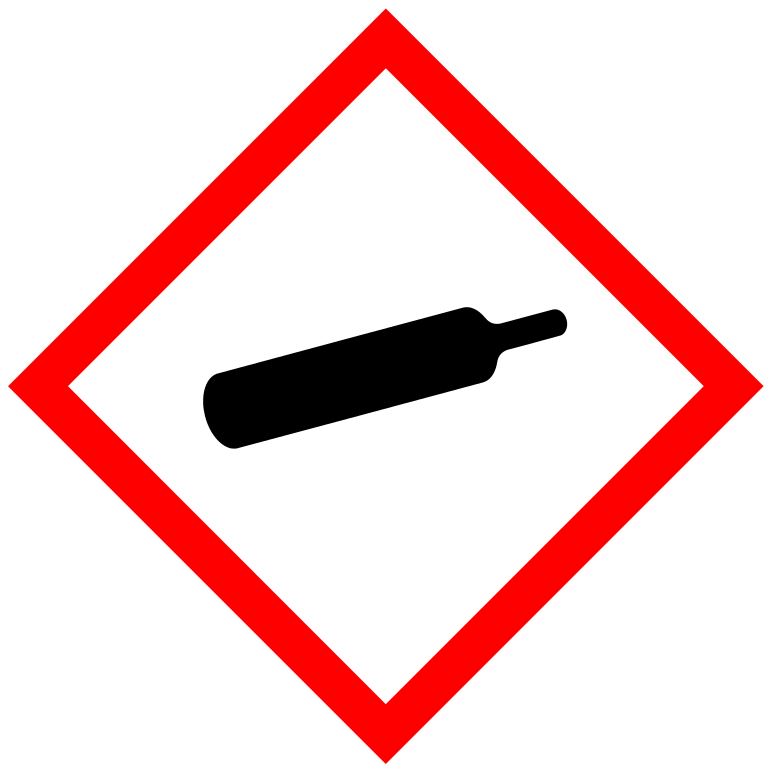
Gas under pressure pictogram (GHS04)
GHS04 · Gas under pressure
Hazard classasphyxiant; greenhouse gas (F-gas Annex I)
GHS signal wordWarning
CLP classificationGases under pressure, liquefied gas; H280
Hazard statementsH280: Contains gas under pressure; may explode if heated.
Lower / upper explosion limitnon-flammable
Auto-ignition temperature532 °C · T1
Seveso III named substanceno
Exposure limits
EU indicative OELV (8 h TWA)no EU IOELV
EU IOELV short-term (15 min)—
Germany AGW (TRGS 900)—
Netherlandswettelijke grenswaarde per Arboregeling bijlage XIII — SER grenswaarden database
NIOSH REL (USA)—
OSHA PEL (USA)—
IDLH—
// Limits change: always confirm the current national value before setting an alarm. Values above were read from the EU directives / GESTIS / NIOSH pages listed in Sources.
Effect on people

Low toxicity (used as a fire-suppression agent at 7–9 vol%); cardiac sensitisation NOAEL ~9 %. Decomposes to HF in fire. Heavier than air (6×).

Recommended monitoring
  • NDIR (8–9 µm) for fire-suppression agent room monitoring (concentration proof after discharge, leak detection of cylinders).
  • Design concentration 7–9 vol%; NOAEL 9 % (cardiac sensitisation).
Climate & atmosphere
GWP₁₀₀ — IPCC AR63600
GWP₁₀₀ — IPCC AR43220
GWP used in Reg. (EU) 2024/5733220
Atmospheric lifetime36 years
Ozone depletion potential0
Main IR absorption band (NDIR)8.0–9.0 µm (C–F stretch, ≈1150–1250 cm⁻¹)
Regulation windows
  • F-gas 2024/573 Annex I (GWP 3220) — fire-protection equipment leak checks
  • ISO 14520 / EN 15004 clean-agent systems
Matching Tremon products

All products, datasheets & manuals →

Share · cite · reuse
Cite this page
Tremon Solutions (2026). HFC-227ea (C₃HF₇) — properties, exposure limits, NDIR monitoring. Tremon gas reference. https://www.tremon.nl/gases/r227ea (accessed 2026-09-17).
BibTeX · embed card · QR
@misc{tremon_r227ea_2026,
  author = {Tremon Solutions},
  title = {HFC-227ea (C3HF7) — properties, exposure limits, NDIR monitoring},
  howpublished = {Tremon gas reference, \url{https://www.tremon.nl/gases/r227ea}},
  year = {2026},
  note = {accessed 2026-09-17}
}
<a href="https://www.tremon.nl/gases/r227ea"><img src="https://www.tremon.nl/assets/og/r227ea.png" alt="HFC-227ea — Tremon gas reference" width="600"></a>

QR code for https://www.tremon.nl/gases/r227ea Download QR Download card Data as JSON

Text and tables on this page: CC BY 4.0 — copy them into your report, SOP or slide with the link above. Data were read from the primary sources listed below; check the current national limit before setting an alarm.
Get a quote

Tell us what you measure — just tap

Three taps and an email. An engineer replies within 24 h with feasibility and a price indication.

1 · Which gas?
2 · What for?
3 · What form?
4 · Where do we reply?
Goes to [email protected]. No newsletter, no tracking.
Other gases
QRhttps://www.tremon.nl/gases/r227ea · Tremon Solutions, Eindhoven · [email protected] · printed from the Tremon gas reference, data as of 2026-09-17 · CC BY 4.0
Sources
  1. https://gestis-database.dguv.de/data?name=490964
  2. https://pubchem.ncbi.nlm.nih.gov/compound/67940
  3. IPCC AR6 WG1 Ch.7 Supplementary Material, Table 7.SM.7 (https://www.ipcc.ch/report/ar6/wg1/downloads/report/IPCC_AR6_WGI_Chapter07_SM.pdf)
  4. IPCC AR4 WG1 Ch.2, Table 2.14 (https://www.ipcc.ch/site/assets/uploads/2018/02/ar4-wg1-chapter2-1.pdf)
  5. Regulation (EU) 2024/573, Annex I/III (https://eur-lex.europa.eu/eli/reg/2024/573/oj)
  6. HITRAN/NIST IR band positions (approximate centre of the strongest band used for NDIR; https://hitran.org, https://webbook.nist.gov)
// Data compiled 2026-09-17 from the listed primary sources; null values were left blank rather than estimated.
Get a quote for this gas →