| Name | Nitrous oxide |
| Formula | N₂O |
| IUPAC name | nitrous oxide |
| CAS number | 10024-97-2 |
| EC number | 233-032-0 |
| UN number | 1070 — Nitrous oxide |
| Transport class (ADR/RID) | 2.2 (Non-flammable, non-toxic gases) |
| PubChem CID | 948 |
| Synonyms | Dinitrogen monoxide, Hyponitrous acid anhydride, Laughing gas |
| Molar mass | 44.01 g/mol |
| Boiling point (1 atm) | -88.5 °C |
| Melting point | -90.8 °C |
| Critical temperature | 36.4 °C |
| Critical pressure | 72.45 bar |
| Vapour pressure | 50.8 bar at 20 °C |
| Gas density | 1.9781 kg/m³ (0 °C, 1013 mbar) |
| Relative density (air = 1) | 1.53 |
| Solubility in water | 1,5 g/l at 15 °C |
| Appearance | gas liquefied under pressure, colourless, sweetish odour |
| Odour | sweetish odour |
| 1 ppm at 20 °C | 1.83 mg/m³ |
Boiling point -88.5 °C at 1 atm: a gas at all normal conditions. Critical point 36.4 °C / 72.45 bar: below this temperature it can be stored as a liquid; cylinder pressure then equals the vapour pressure. Vapour pressure ≈ 50.8 bar at 20 °C — this is the pressure inside a cylinder or a switchgear compartment at that temperature, and it rises steeply with temperature (Clausius–Clapeyron). Relative density 1.53 (air = 1): heavier than air — accumulates in pits, cable basements and at floor level; place sensors low. Conversion at 20 °C, 1013 mbar: 1 ppm = 1.83 mg/m³; NDIR reads partial pressure, so readings scale with absolute pressure (value = reading × P/1013) and must be pressure-compensated.
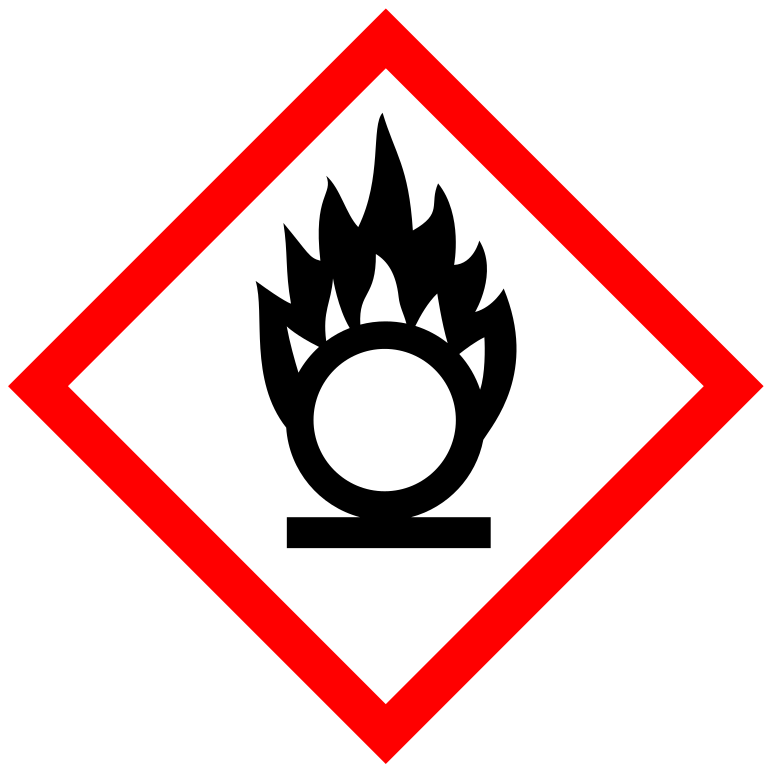

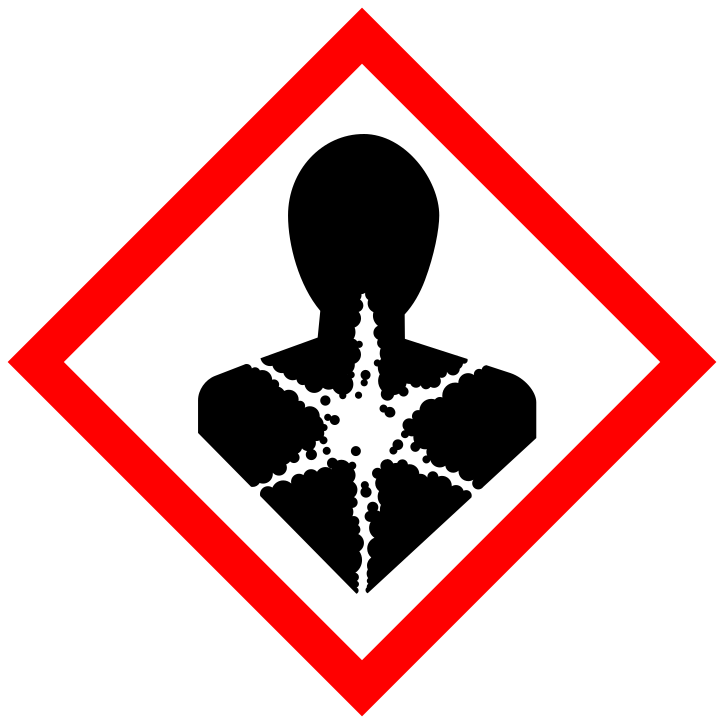
| Hazard class | oxidizer; anaesthetic (toxic at chronic low ppm); greenhouse gas |
| GHS signal word | Danger |
| CLP classification | Oxidising gases, Category 1; H270 Gases under pressure, liquefied gas; H280 Specific Target Organ Toxicity (single exposure), Category 3; H336 Reproductive toxicity, Category 1B; H360Df Specific Target Organ Toxicity (repeated exposure), Category 1; H372 Hazardous to the ozone layer, Category 1; H420 |
| Hazard statements | H270: May cause or intensify fire; oxidiser. H280: Contains gas under pressure; may explode if heated. H336: May cause drowsiness or dizziness. H360Df: May damage the unborn child. Suspected of damaging fertility. H372: Causes damage to organs through prolonged or repeated exposure. H420: Harms public health and the environment by destroying ozone in the upperatmosphere |
| Lower / upper explosion limit | non-flammable |
| Auto-ignition temperature | — |
| Seveso III named substance | yes |
| EU indicative OELV (8 h TWA) | no EU IOELV |
| EU IOELV short-term (15 min) | — |
| Germany AGW (TRGS 900) | 100 ppm · 180 mg/m³ |
| Netherlands | wettelijke grenswaarde per Arboregeling bijlage XIII — SER grenswaarden database |
| NIOSH REL (USA) | TWA 25 ppm (46 mg/m3) (TWA over the time exposed) [*Note: REL for exposure to waste anesthetic gas.] |
| OSHA PEL (USA) | none |
| IDLH | N.D. |
Anaesthetic gas. Acute: euphoria, dizziness, loss of coordination; high concentrations asphyxiate. Chronic low-level exposure (waste anaesthetic gas) inactivates vitamin B₁₂ → neuropathy, and is linked to reproductive effects — hence the 100 ppm (DE) / 25 ppm (NIOSH) limits.
- NDIR at 4.5 µm (with CO₂ cross-compensation) for hospital/dental waste-gas monitoring and for process/CEMS (N₂O is an IED and ETS-reported pollutant).
- Alarm/limit: 100 ppm AGW (DE) / 25 ppm NIOSH TWA for anaesthetic use; agriculture and nitric-acid plants report N₂O under IED/ETS.
| GWP₁₀₀ — IPCC AR6 | 273 |
| GWP₁₀₀ — IPCC AR4 | 298 |
| GWP used in Reg. (EU) 2024/573 | 273 |
| Atmospheric lifetime | 109 years |
| Ozone depletion potential | — |
| Main IR absorption band (NDIR) | 4.5 µm (ν₃, 2224 cm⁻¹); 7.8 µm (ν₁, 1285 cm⁻¹) |
| Note | ODP: N₂O is the dominant ozone-depleting emission of the 21st century (Ravishankara et al. 2009) but has no Montreal-Protocol ODP value assigned. |
- IED 2024/1785 — N₂O is a reported pollutant (nitric/adipic acid, waste incineration)
- EU ETS — N₂O from nitric acid plants
- Workplace: DE AGW 100 ppm; NIOSH REL 25 ppm (anaesthetic waste gas)
Tremon Solutions (2026). Nitrous oxide (N₂O) — properties, exposure limits, NDIR monitoring. Tremon gas reference. https://www.tremon.nl/gases/n2o (accessed 2026-09-17).
BibTeX · embed card · QR
@misc{tremon_n2o_2026,
  author = {Tremon Solutions},
  title = {Nitrous oxide (N2O) — properties, exposure limits, NDIR monitoring},
  howpublished = {Tremon gas reference, \url{https://www.tremon.nl/gases/n2o}},
  year = {2026},
  note = {accessed 2026-09-17}
}
<a href="https://www.tremon.nl/gases/n2o"><img src="https://www.tremon.nl/assets/og/n2o.png" alt="Nitrous oxide — Tremon gas reference" width="600"></a>
Tell us what you measure — just tap
Three taps and an email. An engineer replies within 24 h with feasibility and a price indication.
 https://www.tremon.nl/gases/n2o · Tremon Solutions, Eindhoven · [email protected] · printed from the Tremon gas reference, data as of 2026-09-17 · CC BY 4.0
- https://gestis-database.dguv.de/data?name=004230
- https://www.cdc.gov/niosh/npg/npgd0465.html
- https://pubchem.ncbi.nlm.nih.gov/compound/948
- IPCC AR6 WG1 Ch.7 Supplementary Material, Table 7.SM.7 (https://www.ipcc.ch/report/ar6/wg1/downloads/report/IPCC_AR6_WGI_Chapter07_SM.pdf)
- IPCC AR4 WG1 Ch.2, Table 2.14 (https://www.ipcc.ch/site/assets/uploads/2018/02/ar4-wg1-chapter2-1.pdf)
- Regulation (EU) 2024/573, Annex I/III (https://eur-lex.europa.eu/eli/reg/2024/573/oj)
- HITRAN/NIST IR band positions (approximate centre of the strongest band used for NDIR; https://hitran.org, https://webbook.nist.gov)